 Green Until IntegrationSystems Engineering & Technical LeadershipGet the book
 SPEAKING • PODCASTS • MEDIA • PROFESSIONAL DEVELOPMENT
The most important system problems rarely fit inside one organization.
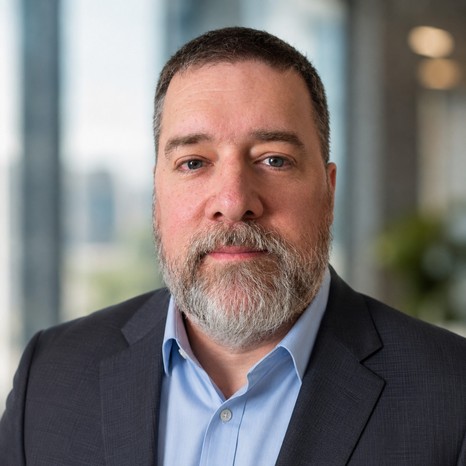
Vito Askins speaks about systems engineering, technical leadership, integration, decision-making, and the failures that emerge between requirements, interfaces, suppliers, teams, and organizational boundaries.
FEATURED SPEAKING TOPICS
Technical sessions built around consequential decisions.
Available as 45–60 minute talks, 90-minute interactive sessions, and selected 2–3 hour workshops.
01Everything Was Green Until Integration
Why local success can still create system failure.
+
Everything Was Green Until Integration
Why local success can still create system failure.
Complex programs are designed, built, verified, and reported through organizational boundaries. That structure is necessary - and it creates a predictable failure mode. Each organization can make a reasonable decision, meet its local requirements, and report healthy status while the interactions between those decisions quietly degrade the mission. This talk uses the fictional TEMPEST program and practical systems-engineering patterns to show how integration exposes distributed decisions, hidden assumptions, weak interfaces, and unowned system behavior. Participants leave with concrete questions for identifying system-level exposure before the integrated event does it for them.
- Best for
- Systems engineers, technical leads, engineering managers, program leaders, aerospace and defense organizations
- Format
- 45-60 minute keynote or technical session; adaptable to 90-minute workshop
02Who Owns the Total?
Technical leadership when responsibility is larger than authority.
+
Who Owns the Total?
Technical leadership when responsibility is larger than authority.
Decomposition makes complex systems buildable by distributing work across specialties, teams, suppliers, and organizations. It also creates a leadership problem: the total mission outcome may depend on people who do not report to one another and decisions no single organization controls. This session explores how technical leaders preserve end-to-end responsibility without becoming the owner of every task. Topics include mission threads, technical authority, decision framing, interface ownership, escalation, and leadership across organizational boundaries.
- Best for
- Senior engineers, IPT leads, systems leads, chief engineers, engineering managers
- Format
- 45-60 minute conference or corporate session; 2-3 hour leadership workshop available
03The RVTM Is Not the System
Traceability is essential. It is not proof of system coherence.
+
The RVTM Is Not the System
Traceability is essential. It is not proof of system coherence.
Requirements traceability is one of the most important control mechanisms in complex engineering. It is also easy to ask it to prove things it cannot prove. This presentation distinguishes requirement lineage from behavioral dependency, trace completeness from mission coverage, and verification closure from system-level evidence. It shows where time, state, emergence, interfaces, assumptions, and mission threads require complementary engineering views. The message is not anti-process: strong artifacts matter. The mistake is treating artifact completeness as equivalent to understanding the system.
- Best for
- Systems engineers, requirements engineers, verification leads, MBSE practitioners
- Format
- 45-60 minute technical presentation or 90-minute interactive session
04Reviews Don’t Reduce Risk. Decisions Do.
Reframing technical reviews as decision mechanisms.
+
Reviews Don’t Reduce Risk. Decisions Do.
Reframing technical reviews as decision mechanisms.
A program can conduct flawless technical reviews and still fail to reduce technical risk. This session reframes PDR, CDR, TRR, ORR, and internal reviews around the decisions the evidence is supposed to enable. It examines entrance criteria, decision authority, risk communication, unresolved uncertainty, residual risk, and the difference between presentation completeness and decision readiness. The objective is to help teams design reviews that change technical exposure rather than merely document status.
- Best for
- Program leaders, chief engineers, systems leads, review boards, technical managers
- Format
- 45-60 minute leadership session; half-day review-effectiveness workshop available
05Local Success, Global Failure
How legitimate optimization creates emergent system problems.
+
Local Success, Global Failure
How legitimate optimization creates emergent system problems.
Spacecraft optimizes determinism. Ground optimizes utilization. Processing optimizes efficiency. Science optimizes product quality. Every choice can be technically defensible, yet the combined system may still miss the mission outcome. This talk examines local objective functions, distributed trade decisions, technical performance budgets, incentives, and emergent behavior. It gives leaders a practical framework for asking whether individual optimizations still add up to the mission the organization intended to deliver.
- Best for
- Aerospace, defense, software-intensive systems, systems-of-systems, program and engineering leadership
- Format
- 45-60 minute technical or executive session
ABOUT VITO ASKINS
Practitioner perspective from more than 25 years in intelligence and aerospace.
Vito Askins is an aerospace systems engineering and technical leader with more than 25 years of experience across intelligence and aerospace programs. His work focuses on the problems that emerge between technical disciplines, organizational boundaries, requirements, interfaces, integration, and mission outcomes. He is the author of Everything Was Green Until Integration and founder of Green Until Integration Consulting.
Read the full biography →MEDIA RESOURCES
Approved assets and language.
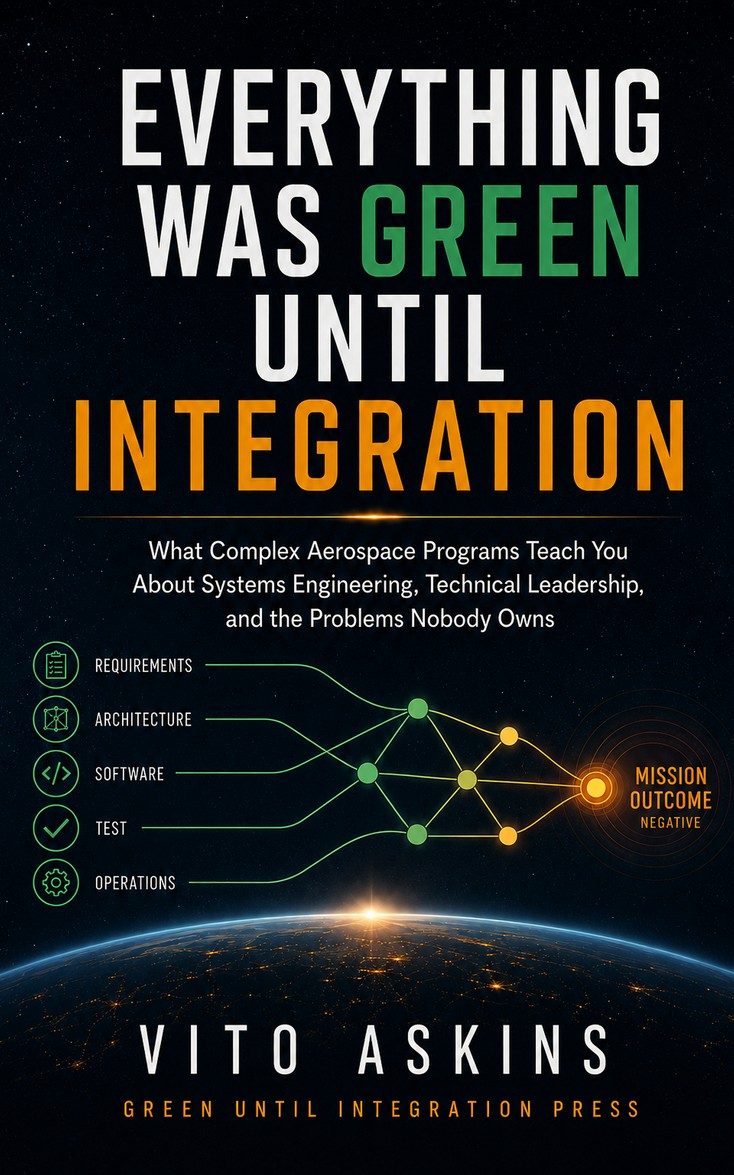
Media and event organizers may use the approved biography, book description, cover image, and headshot for editorial coverage, interviews, event promotion, reviews, and professional-program materials related to Vito Askins, Green Until Integration, or Everything Was Green Until Integration. Substantive excerpts from the book should be requested separately.
Approved 50-word biography +
Vito Askins is an aerospace systems engineering and technical leader with more than 25 years of experience across intelligence and aerospace programs. His work focuses on the problems that emerge between technical disciplines, organizational boundaries, requirements, interfaces, integration, and mission outcomes. He is the author of Everything Was Green Until Integration and founder of Green Until Integration Consulting.
Approved 150-word biography +
Vito Askins is an aerospace systems engineering and technical leader with more than 25 years of experience across intelligence and aerospace programs. His career spans systems engineering, software development, integration and test, mission operations, technical leadership, and the delivery of complex operational space capabilities. His work has focused on the problems that emerge between technical disciplines, organizational boundaries, requirements, interfaces, and mission outcomes. Askins is the founder of Green Until Integration Consulting, where he develops practical approaches to systems engineering, integration readiness, technical leadership, and cross-functional decision-making. He is the author of Everything Was Green Until Integration: What Complex Aerospace Programs Teach You About Systems Engineering, Technical Leadership, and the Problems Nobody Owns. His central thesis is that systems engineering exists to manage the consequences of distributed decision-making - especially when every team can be locally correct while the complete system is still wrong.
SPEAKING INQUIRY
Invite Vito to speak.
Share the event, audience, format, and topic you are considering. Green Until Integration will respond through the business email address you provide.
MEDIA • REVIEWERS • EDUCATORS
Request a review copy
Review copies are available for qualified media, reviewers, professional associations, podcasters, librarians, faculty, and event organizers considering editorial coverage, interviews, course use, or professional programming. Please provide enough information for us to understand the outlet, audience, and intended use.
A shipping address is not requested here. It will be collected only after approval if a print copy is being sent.